The Standing Reservation: How a Weekly Table Is Becoming America's Most Meaningful Social Commitment
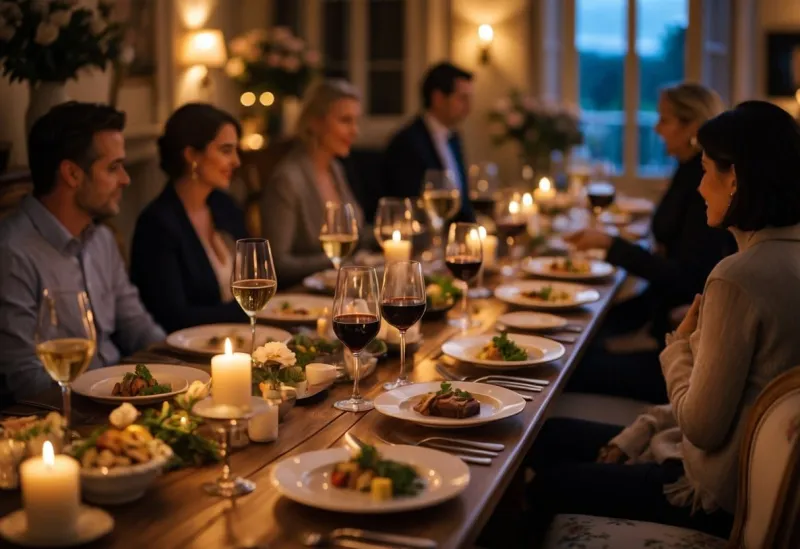
Photo: friends gathering dinner table French brasserie warm restaurant ambiance evening, via amazingfoodanddrink.com
Every Thursday evening at seven o'clock, a table for four is held at a brasserie in Washington, D.C. The same four people have occupied it for nearly three years. They did not begin with the intention of establishing a ritual. They simply returned the following week because the first evening had been so unexpectedly restorative—the warmth of the room, the unhurried pace of the meal, the conversation that ranged freely across two hours without the interruption of a screen or a delivery notification. By the third week, the reservation was no longer a decision. It was an appointment.
This is not an isolated story. Across American cities, a recognizable pattern is emerging: individuals, couples, and small groups are securing recurring reservations at brasseries and French-inspired restaurants with a regularity that suggests something more purposeful than dining convenience. They are, in effect, building their social lives around a table.
The Brasserie as Social Architecture
In France, the brasserie has never been understood primarily as a place to eat. It is, more precisely, a place to be—a room that holds the community, absorbs its conversations, and provides the neutral ground on which relationships are sustained over time. The Parisian who has lunched at the same zinc-countered establishment every Wednesday for fifteen years is not a creature of habit in any diminished sense. He is participating in one of the oldest forms of civic life available to him.
American culture has historically located its equivalent rituals elsewhere: in the church hall, the neighborhood bar, the family dining room. But as these institutions have weakened—attendance declining, neighborhoods dispersing, family dinners surrendering to individual schedules—the social architecture that once held communities together has eroded without an obvious replacement.
The brasserie, it turns out, is filling that vacancy. Its combination of formality and accessibility, of occasion and regularity, makes it uniquely suited to serve as the setting for the kind of sustained, embodied social life that digital communication cannot replicate.
What a Reservation Actually Commits You To
There is something worth examining in the act of making a reservation itself. Unlike a text message proposing plans or a calendar invitation that can be declined with a single click, a restaurant reservation carries a different quality of commitment. It involves a third party—the restaurant—that has allocated a physical table, adjusted its staffing, and anticipated your arrival. Canceling requires an action. Keeping the reservation requires only showing up.
This asymmetry matters more than it might appear. In an era when social commitments have become increasingly provisional—when plans are made with the implicit understanding that they may be revised, postponed, or abandoned depending on how one feels on the day—the reservation functions as a small but meaningful form of social contract. You told someone you would be there. You reserved a table. You are going.
For many Americans who have adopted the standing reservation as a practice, this sense of obligation is not a burden. It is, rather, precisely the point. The commitment removes the weekly negotiation of whether to gather, freeing the participants to focus entirely on the gathering itself.
The Counter-Movement to Digital Isolation
The timing of this trend is not coincidental. The years following the pandemic produced a paradox in American social life: digital connectivity expanded dramatically while genuine social intimacy contracted. People who had spent months communicating exclusively through screens emerged with a sharpened awareness of what those screens could not provide—the weight of shared physical space, the nonverbal texture of a real conversation, the particular quality of attention that arises when two people sit across from each other with nothing else to do.
The brasserie, with its emphasis on the unhurried meal, its relative freedom from the ambient noise of televisions and competitive music, and its implicit expectation that diners will remain at the table for the duration of an evening, offers something that has become genuinely scarce: a protected space for human presence.
Restaurants that have cultivated this quality—that have designed their rooms and their service philosophy around the idea of the long, comfortable visit—are finding that their regulars are fiercely loyal. These are not diners who are simply satisfied with the food. They are diners who have organized a portion of their social lives around the establishment, and who would experience its closure as something closer to a personal loss than a consumer inconvenience.
Predictability as a Form of Richness
One of the unexpected pleasures that standing-reservation regulars frequently describe is the depth of relationship that develops with the restaurant itself—with its staff, its rhythms, its seasonal shifts in menu and atmosphere. The server who remembers that you prefer your steak frites with the sauce on the side. The maître d' who greets you by name and leads you to your usual table without consultation. The gradual accumulation of small recognitions that transform a commercial space into something that feels, over time, genuinely personal.
This is the brasserie relationship at its fullest expression—not the single exceptional meal, but the long, comfortable familiarity of the regular. French dining culture has always understood that the restaurant's greatest gift to its most devoted guests is not the extraordinary evening but the reliable one: the knowledge that the room will be as expected, the food as remembered, the experience as it has always been.
Americans are discovering this truth with something approaching surprise. In a consumer culture that has relentlessly emphasized novelty, variety, and the perpetual search for the next great thing, the appeal of the known and the consistent is proving more powerful than anticipated.
Reclaiming the Table as Sacred Ground
There is a phrase that French hosts use when welcoming guests to a table: vous êtes chez vous—you are at home here. It is an invitation to relax into the space, to release the obligations of the exterior world, and to be, for the duration of the meal, simply present.
The Americans who are building their social lives around a standing brasserie reservation are, in their own way, seeking exactly this. They are claiming a space that is reliably theirs, a rhythm that structures the week, a commitment that resists the frictionless cancellations of modern social life. They are, in the most practical terms imaginable, deciding that the table matters—that the act of sitting down together, in a room designed for exactly that purpose, is worth protecting.
The French brasserie has known this for centuries. America, it seems, is finally arriving at the same conclusion.