The Case for the Long Lunch: What Burnt-Out American Professionals Can Learn from the French Déjeuner
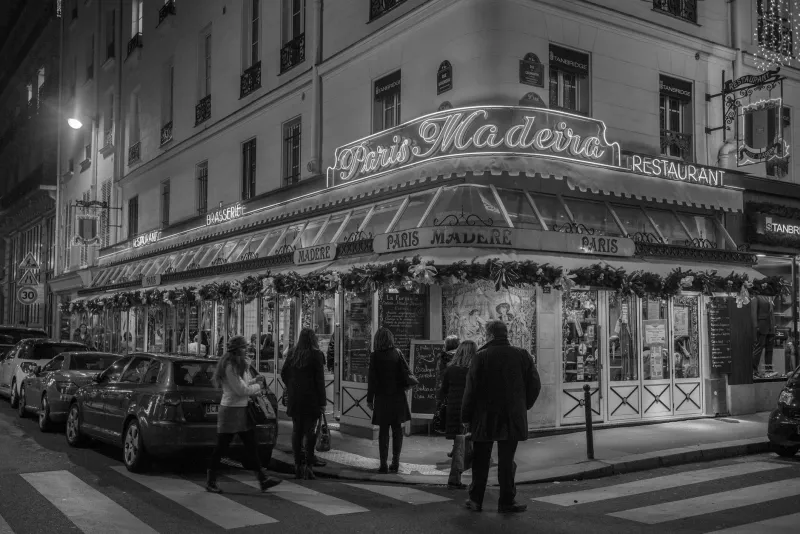
There is a moment, familiar to anyone who has lunched in Paris on a weekday, when the realization arrives: it is 1:15 in the afternoon, the dining room is full, nobody is checking a phone under the table, and the meal has barely begun.
For American professionals conditioned to eat in twelve-minute increments between calendar blocks, the scene can feel almost transgressive. Yet in France, the leisurely midday meal is not an indulgence. It is infrastructure.
A Institution Built Over Generations
The déjeuner occupies a protected place in the French day. Shops close. Meetings yield. The brasserie—the very institution Anisette Brasserie draws its spirit from—was designed around this rhythm, with its mirrored walls and bentwood chairs built for lingering rather than turnover.
This is not laziness dressed in better lighting. French labor culture treats the midday break as a genuine pause: a time to eat properly, converse, and step away from the demands of the morning. The meal is unhurried by design—an appetizer, a plat, perhaps cheese, perhaps dessert, all taken at a pace that would strike most American office workers as fantasy.
The American Counterexample
Compare this to the dominant American midday ritual: the desk lunch. The term itself is telling. We have folded the meal into the workday so thoroughly that eating has become a task, performed at the same station where the work happens, often while continuing to work.
The costs are not abstract. Research on workplace performance has repeatedly found that genuine breaks—particularly breaks involving a change of scenery, movement, and social contact—improve afternoon focus, decision quality, and creative problem-solving. A meal eaten in front of a screen delivers none of this. It is fuel without recovery, calories without restoration.
Burnout researchers make a related point: recovery is most effective when it is psychologically detached from work. A lunch spent answering emails is not a break, whatever the calendar says. A lunch spent at a table, with a plate that requires attention and a companion who requires conversation, is.
The Brasserie as a Model
What the French brasserie understands, and what a growing number of American restaurants are rediscovering, is that lunch is a distinct meal with its own tempo. It is not dinner in smaller portions. It is a hinge—the moment that separates the day's first half from its second.
At Anisette Brasserie, we think often about this tempo. A proper déjeuner might mean a salade composée and a glass of something cold, or it might mean steak and frites and an hour and a half of good company. The duration matters less than the posture: seated, present, and unreachable for a little while.
A Practical Playbook for Reclaiming the Hour
For the American professional persuaded by the argument but constrained by the calendar, the French model need not be adopted wholesale. Consider a staged approach.
First, audit the current lunch. Most desk lunches are habits, not decisions. Simply naming the pattern—identifying how many midday meals in a given week are eaten without pleasure or pause—often creates the opening for change.
Second, start with one protected lunch per week. Put it on the calendar as firmly as a client meeting, and treat it with the same integrity. Choose a restaurant with table service rather than a counter. The friction of a proper restaurant—the menu, the pacing, the waiter who will not be rushed—is precisely the point.
Third, eat with someone. The French déjeuner is a social meal by default, and conversation is the most reliable way to prevent the laptop from reopening. A colleague, a friend, a mentor: the identity matters less than the presence of another person who expects your attention.
Fourth, resist the compression instinct. The goal is not a two-hour lunch on day one. It is a forty-five-minute lunch eaten at a table, phone silenced, food actually tasted. That modest version already delivers most of the benefit.
Finally, notice the afternoon that follows. The evidence in favor of real breaks is compelling on paper, but it becomes persuasive in the body—when the 3 p.m. fog that usually arrives fails to appear.
A Modest Revolution, Served at Noon
No single lunch will fix a culture of overwork. But cultures are made of accumulated habits, and the midday meal is among the most accumulative habits a professional has. Five lunches a week, fifty weeks a year: that is a meaningful quantity of life spent either recovering or merely refueling.
The French figured this out generations ago, not through productivity science but through conviction—that a meal taken properly is worth the time it costs, and that a society that eats well at noon tends to work better in the afternoon. Americans do not need to move to Paris to borrow the insight. They need only to close the laptop, find a table, and give the middle of the day the respect it was always owed.