The Courage of the Unchanged Menu: What French Brasseries Know About Staying the Course
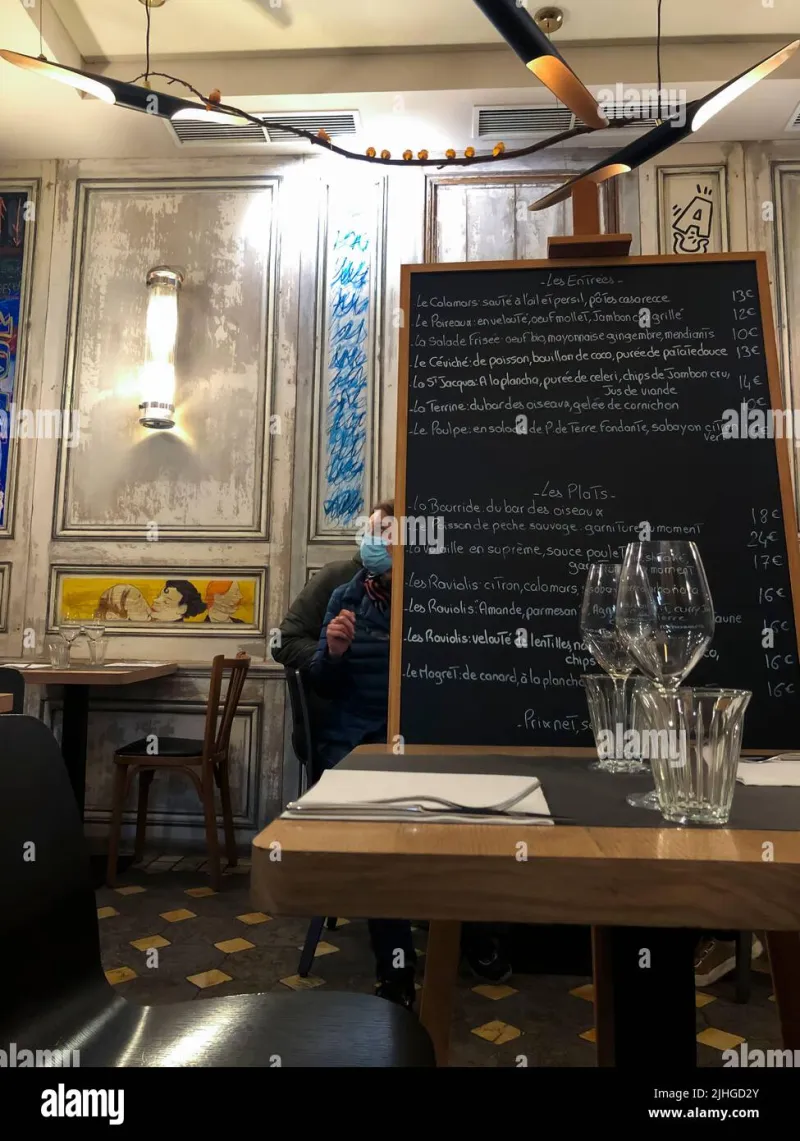
Photo: classic French brasserie menu chalkboard traditional bistro interior, via c8.alamy.com
There is a brasserie in Lyon that has served the same quenelles de brochet for forty-three years. The recipe has not been adjusted for gluten-free diners. It has not been reimagined as a small plate. It has not been deconstructed, elevated, or otherwise subjected to the anxieties of the contemporary restaurant industry. It simply exists, as it always has, in its original form—and the dining room is full every evening.
This is not an accident. It is a declaration.
The Menu as Identity
In France, the brasserie menu is not a document in flux. It is closer to a constitution—a codified expression of what a kitchen believes, what it has mastered, and what it intends to offer the world. The steak frites, the soupe à l'oignon, the tarte Tatin: these are not dishes that survived because no one thought to replace them. They survived because the kitchen actively chose to protect them.
This distinction matters enormously. American restaurant culture tends to treat the menu as a living, breathing organism that must continuously adapt to remain relevant. Seasonal rotations, trend-responsive additions, and dietary-accommodation expansions are standard practice across the country. A new protein gains cultural momentum, and within months it appears on menus from Portland to Miami. A dietary movement swells, and kitchens scramble to accommodate it, often at the expense of their original culinary logic.
The French brasserie operates from a different premise entirely: that relevance is not earned by chasing the moment, but by perfecting a vision and holding it steady.
The Economics of Restraint
There is a practical argument embedded within this philosophy, and it is one that American restaurateurs would do well to examine closely. A focused menu is a more executable menu. When a kitchen commits to a finite set of dishes, it can source ingredients with greater precision, train its cooks to a higher standard of consistency, and reduce the operational waste that plagues establishments attempting to be all things to all diners.
The French brasserie has long understood that depth of mastery is more valuable than breadth of offering. A kitchen that has prepared moules marinières ten thousand times will produce a version that no trend-chasing competitor can replicate on short notice. That accumulated knowledge—the precise moment to pull the mussels from the heat, the exact proportion of white wine to shallot, the way the broth should smell before the cream is added—is institutional capital. It cannot be downloaded. It cannot be pivoted into.
American restaurants that reinvent their menus seasonally or in response to trending ingredients are, in a very real sense, starting over with each iteration. They are forfeiting the compounding returns that come from repetition, refinement, and deep familiarity.
What Diners Actually Want
There is a hospitality assumption embedded in constant menu reinvention: that diners crave novelty above all else. The evidence, however, suggests otherwise. Ask a devoted regular at any long-standing brasserie what they ordered on their most recent visit, and the answer is frequently the same dish they ordered on their first. The croque monsieur. The salade niçoise. The pot-au-feu on a cold Tuesday in February.
This is not a failure of imagination on the diner's part. It is the expression of a profound satisfaction—the comfort of knowing that a beloved dish will be exactly as remembered, prepared with the same care, arriving at the table in its familiar form. In a world of relentless uncertainty, the reliable plate is an act of generosity.
American diners are beginning to recognize this. The rise of what food writers have taken to calling "comfort permanence"—the desire for restaurants that do not surprise, do not reinvent, do not pivot—reflects a cultural exhaustion with novelty for its own sake. The brasserie, with its unchanging menu and its unwavering commitment to a specific culinary vision, is precisely positioned to meet this moment.
The Discipline of Saying No
Perhaps the most instructive aspect of the French brasserie's approach is not what it offers, but what it declines to offer. When a diner requests a gluten-free version of the crêpes Suzette, a traditional brasserie will, with great courtesy and without apology, explain that the dish is not available in an alternative form. When a trend toward plant-based proteins sweeps through the culinary press, the brasserie notes it with interest and continues preparing its confit de canard.
This is not indifference to the customer. It is, paradoxically, a form of respect. The brasserie is communicating something essential: we know who we are, and we trust that you came here because of that. There is an integrity in this position that diners sense, even when they cannot articulate it. A restaurant that will do anything for anyone communicates, however unintentionally, that it stands for nothing in particular.
The American restaurant industry, so deeply committed to the principle of customer accommodation, often struggles with this concept. But the most enduring establishments in this country—the steakhouses that have served the same cuts for decades, the Italian-American red-sauce institutions that have not altered their Sunday gravy in living memory—demonstrate that the principle translates across cultures.
A Lesson Worth Absorbing
The French brasserie's refusal to chase trends is, at its core, an act of culinary confidence. It requires a kitchen to decide, clearly and finally, what it does and does not do—and then to defend that decision against the considerable pressures of a market that rewards novelty and punishes stasis.
For American restaurants willing to adopt this discipline, the rewards are significant. A clearly defined menu communicates expertise. A kitchen that has mastered its repertoire produces food of a consistency that earns genuine loyalty. And a dining room that offers the same beloved dishes week after week becomes, in time, something no trend-responsive competitor can manufacture: a place that people think of as theirs.
The brasserie does not chase the diner. It trusts that the diner, eventually, will find their way to the table. And then it trusts that what arrives on the plate will be sufficient reason to return.
In the end, the unchanged menu is not a limitation. It is an invitation—to sit, to order with confidence, and to experience the quiet pleasure of a kitchen that has decided, with great conviction, exactly what it wishes to cook.