Sound as Seasoning: What French Brasseries Understand About Music That American Restaurants Have Yet to Learn
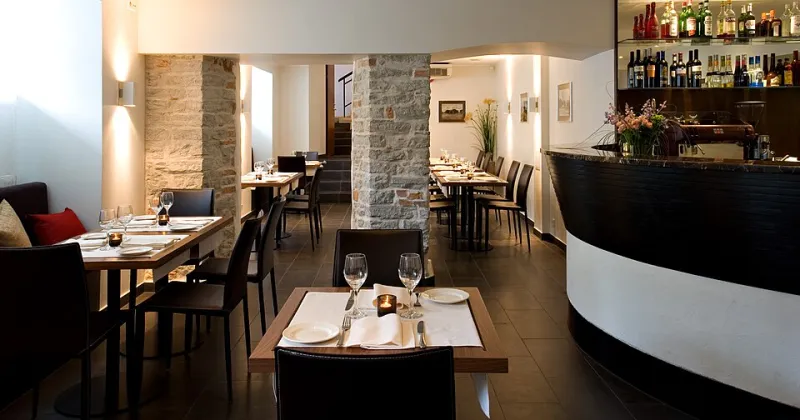
Photo: Unique Hotels, CC BY-SA 2.0, via Wikimedia Commons
There is a moment, familiar to anyone who has dined in a well-appointed Parisian brasserie, when the room simply feels right. The conversation flows without effort, the wine seems more expressive, and the meal unfolds with a rhythm that appears effortless. Much of this is attributed, correctly, to the quality of the food, the attentiveness of the service, or the architecture of the room itself. Yet there is another element at work — one that operates below conscious awareness and is rarely credited with the power it genuinely holds. That element is music.
In the great brasseries of France, music is not decoration. It is not a playlist assembled in haste by a junior manager on a Tuesday afternoon. It is a deliberate atmospheric choice, as considered as the weight of the silverware or the temperature at which the Sancerre is served. American restaurants, by contrast, frequently treat their sonic environment as an afterthought — and their guests feel the consequences, whether or not they can name them.
Volume as Vocabulary
The first principle of brasserie music culture is one of restraint. Volume in a French dining room is calibrated not to fill silence but to cushion it. The goal is a sound level at which two people seated across a small table may converse in ordinary tones without leaning forward, without raising their voices, and without the fatigue that accumulates over a two-hour meal spent shouting pleasantries over a wall of sound.
This is not an accident of preference. French hospitality philosophy holds that the table is a social instrument — a place where relationships are maintained, ideas are exchanged, and the day is examined. Music that competes with conversation is music that works against the meal's fundamental purpose. American dining culture, shaped in part by the belief that energy and volume are synonymous, has too often mistaken loudness for vitality. The result is a generation of restaurants where decibel levels rival those of a moderately busy construction site and where intimacy is simply not available as an option.
Genre as Intention
What plays in a French brasserie is as telling as how loudly it plays. The canon tends to draw from a specific emotional register: the classic chansons of Georges Brassens or Jacques Brel during the earlier hours of service, perhaps giving way to something softer and more instrumental — a Parisian jazz trio, a restrained bossa nova recording — as the evening deepens and the room settles into its later, more contemplative mood.
This sequencing is intentional. Early in service, when guests are arriving, taking their seats, and orienting themselves to the evening, slightly more present music provides a sense of welcome and social permission. It signals that the room is alive. As dinner progresses and the room fills with its own ambient energy — the murmur of conversation, the sound of glassware, the distant choreography of the kitchen — the music recedes further into the background, content to hold the room rather than command it.
American restaurants that have adopted this principle thoughtfully — certain French-influenced establishments in cities like New York, San Francisco, and New Orleans come readily to mind — report something their guests confirm: people stay longer, spend more on wine, and describe the evening in warmer terms. The correlation between acoustic comfort and perceived hospitality is not incidental.
Timing as Craft
There is a third dimension to the French approach that is perhaps the most subtle: the awareness of timing within the meal itself. A brasserie that understands its craft will modulate the music in response to the room rather than on a fixed schedule. When a large party erupts in laughter and the ambient noise level rises organically, the music may be adjusted slightly upward to maintain its presence. During the quieter passages of a weeknight dinner, it may drop further, allowing the room to breathe.
This responsiveness requires someone — a maître d', a senior server, someone with genuine authority over the room — to be paying attention. It is, in essence, a form of hospitality that most American restaurants have not institutionalized, in part because it requires both the authority and the aesthetic education to act on what one observes.
A Practical Guide for the Home Table
For those who entertain at home and wish to apply these principles, the path is more accessible than one might expect. The following framework draws directly from the brasserie tradition:
Begin with restraint. Set your initial volume at a level where you can hold a conversation in a normal voice without the music intruding. If you find yourself speaking over it within the first ten minutes, it is already too loud.
Build a sequence, not a shuffle. A randomized playlist is the enemy of atmosphere. Curate a sequence that moves from slightly more present to progressively more ambient as the evening advances. Begin with Edith Piaf or a classic French chanson recording; transition to a Parisian jazz selection during the main course; allow something purely instrumental — Erik Satie's piano works are an ideal choice — to carry the room through dessert and conversation.
Respect the pause. The French understand that silence, briefly held, is not a failure of hospitality. Between courses, a moment without music is not empty — it is spacious. Allow the room to hold its own sound occasionally.
Avoid the obvious. A dinner party is not a film score, and your guests are not an audience. Music that is too recognizable, too associated with other contexts, or too emotionally insistent pulls attention away from the table. The best brasserie music is music that guests notice only when it stops.
What Is Actually at Stake
It would be easy to dismiss the question of dining music as a matter of personal taste, too minor to merit serious consideration. Yet the French have understood for generations that every element of the dining environment communicates something to the guest — and that the cumulative effect of these communications determines whether a meal is merely consumed or genuinely experienced.
Sound shapes mood. Mood shapes conversation. Conversation shapes the quality of an evening. In this light, the playlist is not a trivial detail but a quiet form of hospitality — one that the French brasserie has refined over decades and that the American table is only beginning to appreciate.