Three Elements, Infinite Confidence: Mastering the Minimalist Logic of the French Bistro Plate
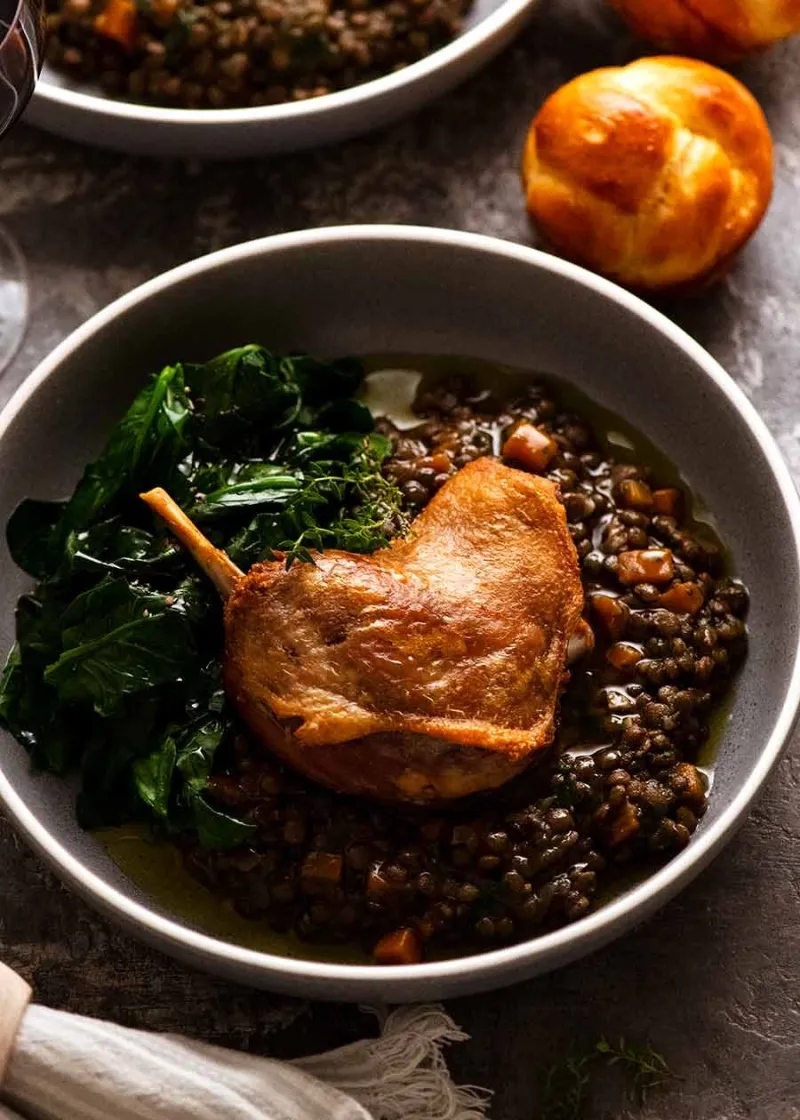
Photo: French bistro minimalist plating duck confit lentils elegant, via www.recipetineats.com
Consider the classic French bistro presentation of duck confit: a single leg, rendered to a deep mahogany lacquer, resting beside a small mound of Puy lentils dressed with a mustard vinaigrette, and perhaps a few leaves of frisée to provide contrast and brightness. That is it. Three elements, carefully considered, executed with precision. No garnish beyond what contributes flavor. No sauce pooled decoratively across the plate in an abstract gesture. No architectural stacking to signal effort.
And yet, when the plate arrives at the table, it is unambiguously complete.
This is the paradox that confounds many American home cooks who encounter French bistro cuisine for the first time — either in France, at a restaurant in the French tradition, or in the pages of a cookbook. The simplicity reads, to eyes trained by a culture that equates abundance with generosity and complexity with competence, as something almost confrontational. Where is the rest of it?
The rest of it, as it turns out, is in the technique.
The American Instinct to Add
American home cooking culture, for all its genuine creativity, has long operated under a set of assumptions that work against minimalism. More ingredients suggest more effort. A crowded plate signals abundance, which signals hospitality. Garnishes, sauces, and accompaniments are understood as additions that improve a dish, and the absence of any of them can feel like an omission rather than a choice.
This instinct is not irrational. It has roots in a hospitality culture that prizes generosity, in a restaurant industry that has historically used portion size as a primary value proposition, and in a food media environment that rewards visual complexity. The result is home cooking that is often technically ambitious but tonally cluttered — dishes in which too many competing flavors prevent any single one from being fully heard.
French bistro cooking begins from the opposite premise. Every element on the plate must earn its place. If an ingredient does not contribute a distinct flavor, texture, or structural function, it is not included. Decoration is not a category. A sprig of parsley placed for color alone would be regarded, in a traditional French kitchen, as a failure of imagination — a confession that the cook did not trust the dish to speak for itself.
What Restraint Actually Requires
The reason French bistro simplicity intimidates home cooks is not that it is easy. It is that it is unforgiving. When a plate contains only three elements, each of those elements must be executed without error. There is no complexity to hide behind, no abundance of flavors to mask a technique that fell slightly short.
The duck confit must be properly cured, properly rendered, and properly rested. The lentils must be cooked to the precise point of tenderness without losing their structural integrity, and the vinaigrette must be balanced to the decimal. The frisée must be fresh, dressed at the last moment, and seasoned correctly. None of these steps is especially difficult. All of them require attention.
This is the central insight that French culinary training instills early: simplicity is not the absence of skill. It is the highest expression of it. Any competent cook can obscure a mediocre ingredient behind a complex preparation. It takes genuine confidence — and genuine technique — to present that ingredient plainly and allow it to be judged on its own terms.
A Framework for Building Bistro-Quality Dishes at Home
For American home cooks who want to bring this quality to their own kitchens, the shift is less about learning new techniques than about unlearning old habits. The following framework, drawn from the principles that govern French bistro cooking, provides a practical starting point.
Begin with one exceptional ingredient. The French bistro plate is almost always organized around a single primary element — a protein, a seasonal vegetable, or, occasionally, a legume or grain of particular quality. That element should be the best version of itself you can source. A heritage breed pork chop from a reputable butcher, a bunch of haricots verts at the peak of the season, a free-range chicken thigh — these do not require elaborate treatment. They require respect.
Choose a second element that provides contrast, not competition. The supporting element of a bistro plate is selected for what it does in relation to the primary ingredient, not for its own complexity. If the protein is rich, the accompaniment should be bright or acidic. If the main element is delicate, the supporting component should provide texture or earthiness. The goal is dialogue, not duplication.
Finish with a sauce that integrates rather than decorates. In French bistro cooking, the sauce is not applied for visual effect. It is the connective tissue of the dish — the element that ties the flavors together and provides the final layer of seasoning. A pan sauce built from the fond of a properly seared piece of meat, deglazed with wine and finished with butter, performs this function perfectly. It does not need to be elaborate. It needs to be correct.
Season at every stage, not merely at the end. One of the most common sources of flat flavor in home cooking is the habit of seasoning only the finished dish. French kitchen practice seasons throughout the process — the sauté, the sauce, the vegetables individually, and finally the assembled plate. This layered approach produces a depth of flavor that cannot be achieved by salting at the table.
Plate with intention, not decoration. When the three elements are ready, place them on a warm plate with deliberate purpose. The protein should have a natural resting position. The accompaniment should be placed where it is accessible without dominating the visual field. The sauce should be applied in a quantity that enhances without flooding. Step back. Resist the impulse to add something more.
The Confidence the Plate Requires
There is a psychological dimension to bistro minimalism that deserves acknowledgment. Placing a simple plate in front of a guest — whether at a restaurant table or a dinner party — requires the cook to trust that the work is sufficient. For many Americans, that trust is difficult to extend, because the cultural signals around food have long equated visual abundance with care.
At Anisette Brasserie, we have observed, again and again, that the plates that produce the most genuine satisfaction are rarely the most complex. They are the ones in which every element is precisely what it should be — nothing more, nothing less. Guests do not leave the table wishing there had been more on the plate. They leave having tasted what was on the plate fully, which is a different and more lasting form of satisfaction.
The French bistro plate is not a compromise. It is an argument — quietly, elegantly made — that cooking at its finest is an act of editing as much as creation. Learning to make that argument at your own table is one of the most rewarding skills a home cook can develop.
Start with three elements. Execute each one with complete attention. Trust the plate.
The rest will follow.