The Secret Foundation of French Cooking: How the Mother Sauces Built a Culinary Empire
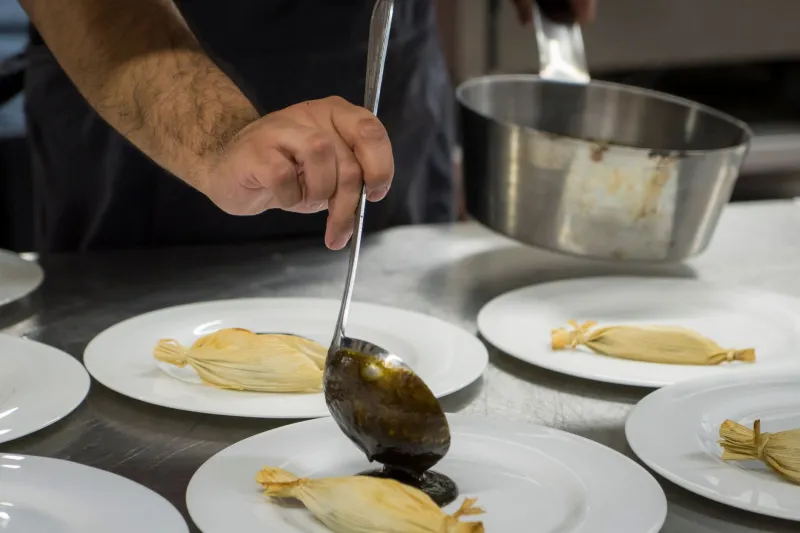
There is a moment that nearly every serious cook eventually encounters — a moment when a dish, despite impeccable ingredients and careful preparation, feels somehow incomplete. The protein is cooked to perfection, the vegetables are vibrant, and yet something essential is absent. In France, a chef would diagnose the problem immediately: there is no sauce.
For generations, American diners have admired French cuisine from a respectful distance, celebrating its elegance while quietly assuming its techniques were beyond reach. The mother sauces — those five foundational preparations that underpin the entire architecture of classical French cooking — occupied a particularly intimidating corner of that admiration. They seemed to belong to white-jacketed brigade kitchens, not to weeknight home cooking in Chicago or Denver or Charlotte.
That assumption, it turns out, has always been mistaken.
What the Mother Sauces Actually Are
The codification of the five mother sauces is most closely associated with Auguste Escoffier, the legendary French chef who systematized classical cuisine in the late nineteenth and early twentieth centuries. His framework identified five foundational preparations from which virtually every other sauce in the French repertoire could be derived.
They are as follows: béchamel, a milk-based sauce thickened with a white roux; velouté, a light stock-based sauce also built on a pale roux; espagnole, a rich brown sauce derived from deeply roasted bones and vegetables; sauce tomat, the French interpretation of tomato sauce; and hollandaise, an emulsified butter sauce enriched with egg yolks and brightened with acid.
Each mother sauce serves as a starting point rather than a destination. From béchamel, one arrives at Mornay, the cheese-enriched sauce that transforms a simple gratin into something memorable. From velouté, a cook can produce suprême sauce by finishing with cream, or a delicate allemande with egg yolk enrichment. Espagnole, reduced and refined, becomes the deeply complex demi-glace that defines the flavor profile of the finest brasserie kitchens. The derivatives extend almost infinitely, which is precisely why mastering the originals is so consequential.
Why American Kitchens Fell Behind
The mid-twentieth century was not kind to the mother sauces in the United States. The postwar era brought with it a cultural enthusiasm for convenience, and the elaborate stock-making and patient reduction that French sauces require seemed at odds with the pace of modern American life. Processed alternatives arrived in cans and packets, and the art of building a sauce from scratch quietly receded.
Chef Marianne Delacroix, a French-trained culinary instructor who now runs sauce workshops out of her studio in New Orleans, describes the shift with characteristic directness. "Americans were told that French cooking was complicated, and they believed it," she explains. "But the truth is that béchamel takes perhaps fifteen minutes to make correctly. What it requires is not time — it is attention. And attention is something Americans are absolutely capable of giving."
Her observation points to something important. The barrier to sauce-making in the American kitchen has rarely been technical. It has been psychological — a deeply embedded belief that classical technique belongs to professionals.
The Brasserie Model as Teacher
One reason the mother sauces are finding new relevance in American dining culture is the growing influence of the brasserie model itself. Unlike the white-tablecloth formality of haute cuisine restaurants, the French brasserie has always occupied a more accessible register — convivial, generous, and rooted in the kind of cooking that nourishes rather than merely impresses.
At its best, brasserie cooking is sauce-forward without being precious about it. A classic steak au poivre derives its character almost entirely from its pan sauce — a careful reduction of cognac, cream, and cracked peppercorns built directly in the pan after searing. A sole meunière is, at its core, an exercise in brown butter sauce. The brasserie teaches, almost by accident, that sauce is not decoration. It is the point.
Chef André Fontaine, who spent twelve years cooking in Lyon before relocating to open his own establishment in Washington, D.C., believes the brasserie format is the ideal entry point for American cooks discovering French technique. "In a brasserie, you see the sauce working," he says. "It is not hidden behind theater. You understand immediately that the sauce is what carries the flavor, what ties everything together. Once you see that, you cannot unsee it."
Building a Home Sauce Pantry
For American home cooks ready to engage seriously with the mother sauces, the most practical first step is not a recipe but a pantry audit. Genuine sauce-making requires a small collection of foundational ingredients that, once assembled, make the process considerably more approachable.
Quality stock is the single most important investment. While commercial stock has improved markedly in recent years, homemade chicken or veal stock remains superior for velouté and espagnole work. The practice of making a large batch on weekends and freezing it in two-cup portions is one of the most efficient habits a serious home cook can adopt.
European-style butter, with its higher fat content, makes a meaningful difference in both béchamel and hollandaise. Brands widely available in American grocery stores — Plugrá and Kerrygold among them — provide the richness that these sauces demand.
A heavy-bottomed saucepan matters more than most cooks realize. Even, gentle heat is essential for preventing scorching in béchamel and for maintaining the delicate emulsion in hollandaise. A thin-bottomed pan introduces unnecessary risk.
Beyond equipment and pantry, the most transformative investment is simply practice. Hollandaise, widely regarded as the most technically demanding of the five, becomes reliable with repetition. Chef Delacroix recommends making it six times in a single month — not for special occasions, but simply to build muscle memory. "By the sixth time," she says, "it is no longer frightening. It is just cooking."
A New Generation of Sauce-Minded Cooks
There are encouraging signs that American cooks are arriving, in growing numbers, at precisely this kind of confidence. The popularity of French culinary content across digital platforms, combined with renewed interest in classical technique among younger home cooks, has created an audience genuinely curious about the mother sauces in ways that would have seemed improbable a decade ago.
This shift is visible in American restaurant culture as well. Menus that might once have featured a simple pan dripping now describe carefully constructed reductions and emulsified finishing sauces. Diners are asking questions they did not previously think to ask, and chefs are answering them with evident pleasure.
The mother sauces, it turns out, were never truly absent from American cooking. They were simply waiting to be rediscovered — waiting for a generation of cooks curious enough to look past the intimidation and find, on the other side, something both ancient and entirely alive.
At Anisette Brasserie, we believe that the French table is not a destination but a practice — one that rewards patience, attention, and the willingness to begin. The mother sauces are, in many ways, the most honest expression of that belief. They ask very little of a cook beyond presence and care. In return, they offer everything.