Substance Over Spectacle: How a New Generation Is Falling in Love with the Honest French Plate
For roughly a decade, the dominant visual language of American restaurant culture has been one of maximalism. Towers of impossibly stacked ingredients. Smears of sauce applied with the deliberate energy of abstract expressionism. Microgreens positioned with the precision of a jeweler. Edible gold leaf. Smoking dry ice. Desserts that arrive at the table in a state of theatrical crisis, requiring the server to pour, drizzle, or ignite something before the guest is permitted to eat.
This aesthetic had a logic. In an era defined by social sharing, the plate that photographed well was the plate that marketed itself. Restaurants competed not merely for palates but for feeds, and the visual arms race produced some genuinely remarkable — if occasionally ridiculous — results.
Now, something is shifting. And the generation driving that shift is the one that, by all conventional wisdom, should have been most devoted to the spectacle.
The Unexpected Retreat from Performance
Among food-engaged Gen Z diners and younger millennials — roughly, those between the ages of twenty-two and thirty-five — there is a discernible and growing appetite for what might be described as culinary sincerity. This is not, it should be noted, a rejection of quality or ambition. It is a rejection of performance for its own sake, and a corresponding embrace of food that communicates through flavor, technique, and restraint rather than visual complexity.
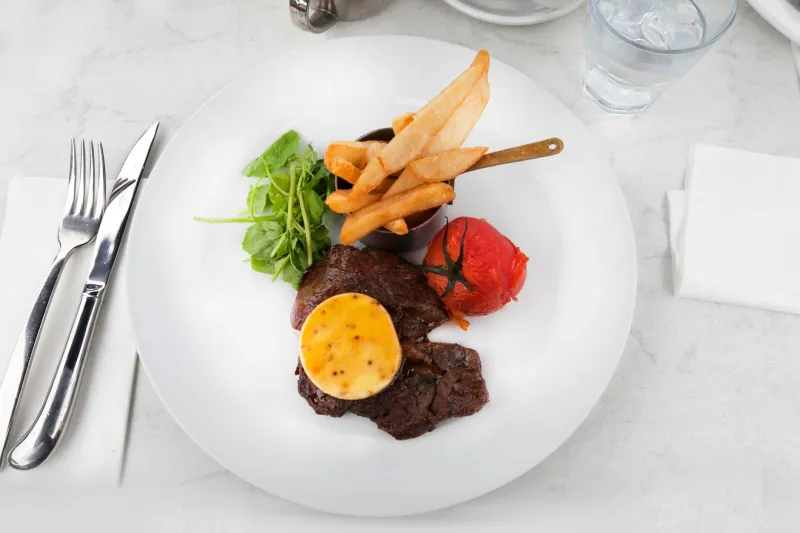
Anecdotally, this shift is visible in the restaurants that are attracting genuine enthusiasm from younger urban diners. The reservations are not flowing to the most elaborate tasting menus or the most aggressively plated small plates. They are flowing, with increasing frequency, to places that serve recognizable food with exceptional skill — roast chicken that tastes definitively of itself, a lentil salad dressed with a vinaigrette of such precise balance that it becomes a revelation, a steak with pommes frites that requires no introduction and no explanation.
This, of course, is the vocabulary of the French bistro. And it is experiencing something of a quiet renaissance among the very demographic that was supposed to be most susceptible to Instagram-driven dining trends.
What the French Bistro Offers That the Trend Plate Cannot
The traditional French bistro plate is, in one sense, almost aggressively unpretentious. A well-executed entrecôte arrives looking like a well-executed entrecôte. A salade Niçoise is composed with care but without theatrical ambition. The visual appeal is real but understated — the appeal of something that has been made correctly rather than something that has been styled.
What this aesthetic offers, and what the maximalist plate frequently cannot, is a direct line to flavor. When the presentation is stripped of distraction, the food must justify itself entirely on its own terms. The sauce must be balanced. The protein must be cooked with precision. The seasoning must be right, because there is nothing to hide behind.
This is, paradoxically, a far more demanding standard than the one imposed by elaborate plating. A dramatic presentation can compensate for a great deal. An honest plate cannot compensate for anything.
Younger diners, it seems, are beginning to understand this distinction — and to value it.
The Cultural Exhaustion Behind the Shift
To understand why this is happening now, it helps to consider what a generation raised on social media actually experiences when it sits down to eat. For a diner who has spent years consuming food content — watching dishes assembled in slow-motion videos, scrolling through carefully filtered restaurant photography, following accounts dedicated entirely to the aesthetics of eating — the photogenic plate has lost much of its power to surprise or delight.
Familiarity, in this context, breeds something close to fatigue. The edible flower is no longer novel. The swoosh of puréed something is no longer interesting. The architectural dessert has become background noise.
What retains the power to surprise, in this saturated visual environment, is precisely what cannot be photographed: flavor. Texture. The experience of eating something that tastes more intensely of itself than you expected. The satisfaction of a dish that delivers exactly what it promises and nothing it does not.
This is the register in which French bistro cooking has always operated. It has simply taken a generation of visual overexposure to make that register feel radical again.
Restraint as a Form of Confidence
There is something worth examining in the aesthetics of the French bistro plate beyond mere simplicity. The decision to present food without embellishment is not, in the hands of a skilled cook, an act of laziness. It is an act of confidence — a declaration that the cooking is sufficient, that the ingredients require no costume, that the diner's attention is best directed toward what is actually in the dish.
This is a quality that younger diners appear to be learning to read, and to respect. In conversation with food-curious twenty-somethings in cities from Austin to Philadelphia, a recurring theme emerges: the desire to eat food that feels real. Not constructed, not engineered for a particular emotional response, not designed to generate a specific reaction on a phone screen — but real, in the sense of being honest about what it is and confident in that honesty.
At Anisette Brasserie, this philosophy has always been central to how we think about the table. The beauty of a properly made moules marinières or a classic tarte tatin lies not in their complexity but in their precision — the accumulated wisdom of a culinary tradition that understood, long before the age of social media, that the most enduring plates are the ones that taste better than they look and feel better than they photograph.
The Plate as a Statement
What the generational drift toward bistro simplicity ultimately reveals is less about food trends than about a broader cultural weariness with performance. In an era when so much of daily life is curated, filtered, and presented for an audience, there is a growing hunger for experiences that resist that logic — that exist purely to be experienced rather than documented.
The humble French bistro plate, with its quiet authority and its refusal to perform, has become, somewhat unexpectedly, one of those experiences. It does not ask to be photographed. It does not require an explanation. It simply asks to be eaten.
For a generation that has grown up surrounded by spectacle, that simplicity is not a limitation. It is, increasingly, the point.