The New Brasserie: How Paris Is Rewriting Its Own Rules — And What American Diners Should Make of It
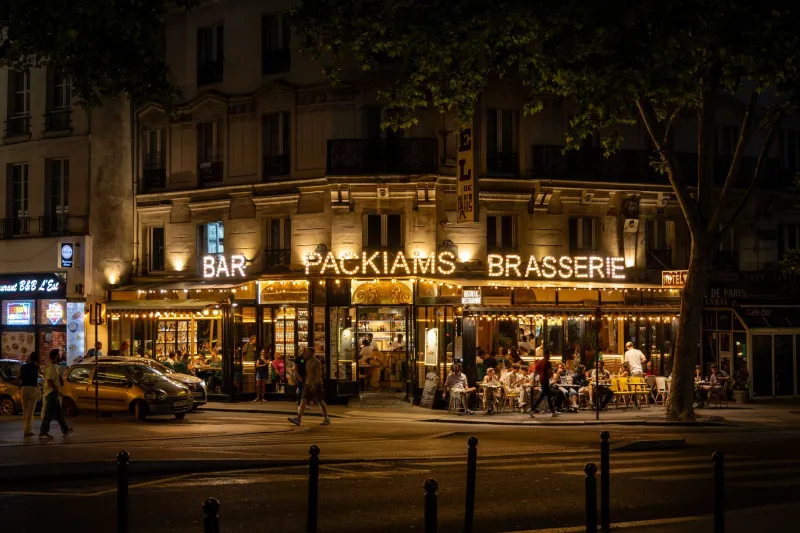
An Institution in Motion
The brasserie has never been a static thing. Born in the 19th century from Alsatian brewing culture and shaped by successive waves of immigration, industrialization, and social change, it has always been a living, adaptive institution. Yet in recent years, the pace of that adaptation has accelerated in ways that are prompting genuine debate among chefs, food critics, and devoted regulars on both sides of the Atlantic.
Establishments that have served the same choucroute garnie and steak tartare for generations are now introducing fermented vegetables, plant-forward small plates, and natural wines that would have seemed incongruous — even heretical — a decade ago. The question worth asking is not whether this change is happening, but what it means, and whether it represents an enrichment of the brasserie tradition or an erosion of it.
At Anisette Brasserie, we find ourselves uniquely positioned to consider this question — as a French-inspired establishment operating in the American context, we navigate the tension between heritage and evolution every day. What follows is an honest examination of what Paris is doing, why it matters, and what American diners and restaurateurs might take from it.
The Pressure Points Reshaping Parisian Dining
Several converging forces have pushed even the most tradition-bound Parisian brasseries toward reinvention. The first is demographic: younger French diners, particularly those in their twenties and thirties, are eating differently than their parents did. They are more likely to be vegetarian or flexitarian, more conscious of sourcing and sustainability, and more interested in global flavor influences. A menu built entirely around cassoulet and escargots does not speak to this audience in the same way it once did.
The second force is economic. The grand brasserie model — with its elaborate dining room staffing, its extensive classical wine lists, and its labor-intensive preparations — operates on margins that have become increasingly difficult to sustain. Simplification is not merely a creative choice; for many establishments, it is a financial necessity.
The third force, perhaps the most interesting, is the influence of a new generation of French chefs who trained in international kitchens before returning home. Having worked in Tokyo, Copenhagen, New York, and London, these cooks bring a broader palate and a willingness to question assumptions that their predecessors might have considered settled.
What Modernization Actually Looks Like
It is important to distinguish between two very different kinds of change occurring simultaneously in Paris. The first is thoughtful evolution — the careful introduction of new ideas that honor the spirit of brasserie cooking while expanding its vocabulary. This might mean a bouillabaisse made with locally sourced Pacific fish by a chef who has moved to Marseille from abroad, or a crème brûlée flavored with yuzu rather than vanilla. The technique, the intention, and the hospitality remain intact; only the specific ingredients or flavor profiles have shifted.
The second kind of change is more radical and more contested: the wholesale reimagining of the brasserie concept, in which the zinc bar and the leather banquettes remain but the menu bears almost no resemblance to what one would have expected to find thirty years ago. Some critics celebrate this as creative courage. Others argue that it strips the brasserie of its essential identity — that it becomes, in effect, a contemporary restaurant wearing a brasserie's clothing.
Neither position is entirely wrong. The brasserie that refuses all change risks becoming a museum piece — a place visited for nostalgia rather than genuine culinary pleasure. But the brasserie that abandons its foundations in pursuit of novelty risks losing the very thing that made it irreplaceable: its sense of place, its comfort, its reliability.
The American Parallel
This tension has a direct American corollary, and it is one that anyone who has watched the evolution of fine dining in this country will recognize immediately. For much of the latter half of the 20th century, French cuisine served as the unquestioned benchmark of serious American restaurant cooking. The shift away from that dominance — driven by the rise of regional American cuisine, farm-to-table philosophy, and global influences — mirrored, in some ways, what is now happening within France itself.
American fine dining has spent the last two decades negotiating its own version of this question: how do you honor a tradition while making room for the present? The most successful establishments — those that have remained relevant without becoming unrecognizable — have tended to answer that question with specificity. They have identified which elements of their tradition are genuinely non-negotiable (a commitment to hospitality, to sourcing, to craft) and which are merely conventional (a particular plating style, a fixed menu format, a certain formality of service).
This is precisely the framework that American restaurateurs watching the Parisian evolution should apply to their own operations. The lesson from Paris is not that everything must change, nor that nothing should. It is that the most enduring institutions are those that understand which of their qualities are essential and which are simply habitual.
The Risk of Authenticity Theater
One cautionary note deserves emphasis, both for Parisian establishments and for their American admirers: the danger of what might be called authenticity theater. This occurs when a restaurant deploys the visual and atmospheric signifiers of a traditional brasserie — the period mirrors, the white-aproned servers, the carefully aged menus — while delivering an experience that is fundamentally disconnected from the culture those signifiers represent.
American diners, who have grown increasingly sophisticated in their culinary literacy, are remarkably good at detecting this disconnect. A restaurant that presents itself as a French brasserie but serves food with no genuine connection to that tradition is not paying homage — it is appropriating an aesthetic for commercial purposes. This is a distinction that matters, and one that the most respected establishments on both continents take seriously.
At Anisette Brasserie, our commitment is to the substance of the French dining tradition rather than merely its surface. The anise-forward aperitifs, the classical preparations, the unhurried pace of service — these are not decorative choices. They are expressions of a genuine culinary philosophy.
What the Future Holds — And What It Should Preserve
The brasseries of Paris that are navigating this moment most gracefully share a common characteristic: they are led by people who can articulate clearly what they believe their restaurant exists to do. They have a point of view — about food, about hospitality, about the role of the dining room in public life — that guides their decisions about what to change and what to protect.
For American diners, the evolution of the Parisian brasserie offers both a source of inspiration and a gentle warning. It is an invitation to engage more deeply with the restaurants we love — to ask not merely whether a dish is delicious, but whether it belongs to something larger: a tradition, a place, a set of values that have been earned over time.
The best brasseries, whether in Paris or in the United States, are not simply restaurants. They are arguments about how people should eat together — with pleasure, with care, and with a sense that the meal, however it has evolved, is still worth the time it takes to enjoy it properly.