The Quiet Plate: How French Brasserie Chefs Use Restraint to Say More
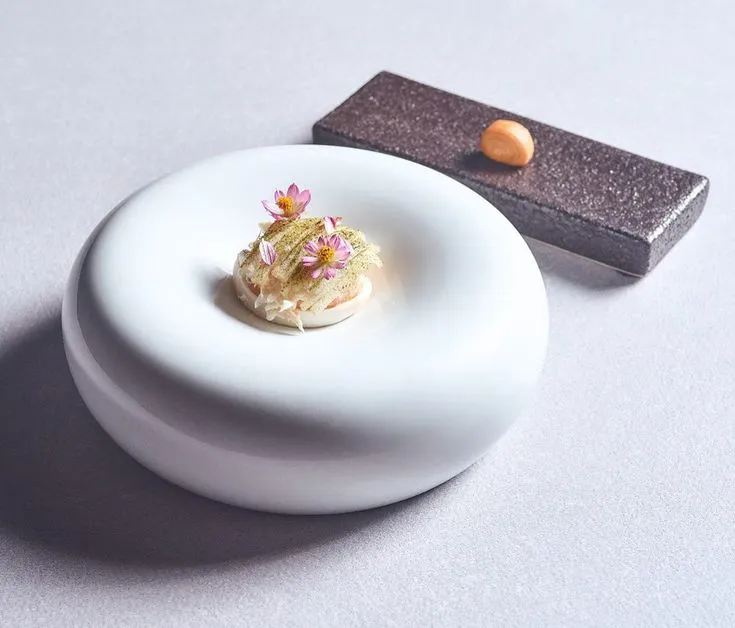
Photo: elegant French brasserie plating minimalist white plate fine dining, via i.pinimg.com
There is a photograph, reproduced in countless French cookbooks, of a simple roasted duck breast resting against a shallow pool of jus, a few sprigs of thyme placed without ceremony at its edge. No smear. No foam. No architectural tower of compressed vegetables leaning at a precarious angle. The plate is half empty by any conventional measure, and yet the image is arresting — precisely because there is nowhere else to look.
This is not minimalism for its own sake. It is a statement of confidence, and it represents one of the most misunderstood principles in contemporary culinary presentation.
When the Plate Became a Stage Set
American fine dining spent much of the last two decades in a race toward visual complexity. Tweezers became standard kitchen equipment. Sauces were applied in deliberate brushstrokes. Components were stacked, compressed, dehydrated, and reconstituted into forms that bore little resemblance to their origins. The plate became, in many cases, a demonstration of technique rather than a vehicle for flavor.
The impulse is understandable. In a culture that increasingly experiences food through a screen — photographed, filtered, and shared before the first bite is taken — visual impact has become a competitive currency. A dish that photographs well earns attention. Attention earns covers. Covers sustain a restaurant.
But something is lost in this transaction. When every element on a plate is fighting for visual prominence, none of them wins. The diner's eye moves restlessly from component to component, and the mind follows — cataloguing, assessing, never fully settling into the experience of eating. The meal becomes an exhibition rather than a conversation.
What Negative Space Actually Does
French brasserie plating operates on a different logic, one borrowed less from visual art than from theater. The empty space on a plate is not emptiness — it is direction. It tells the diner where to look, and in doing so, it tells them what matters.
A properly plated sole meunière at a Parisian brasserie arrives on a wide, white plate. The fish occupies perhaps a third of the surface. A small pool of browned butter gathers at its base. A wedge of lemon rests to one side, not garnished, not carved into a decorative shape. The rest of the plate is bare.
The effect is immediate and clarifying. There is no competition for attention. The eye goes directly to the fish, and the mind follows with a single, focused question: how does it taste? The negative space is not a design choice. It is a rhetorical one. It says, without words, that this ingredient is sufficient — that it requires no elaboration, no distraction, no apology.
This kind of confidence is rare in contemporary American plating, where the impulse to add is almost always stronger than the discipline to stop.
The Ingredient as the Argument
At the center of French brasserie plating philosophy is a conviction that should be obvious but is frequently overlooked: the ingredient is the point. Every additional element on a plate is a claim — an assertion that this component adds something essential. French kitchen culture demands that each claim be justified, and it is suspicious of claims that cannot be.
This is why classical French plating so often appears simple to the untrained eye. A terrine presented in clean slices with a small mound of cornichons and a smear of Dijon. A steak frites with a ramekin of béarnaise placed to the side. A crème brûlée in a plain white ramekin, its caramelized surface unadorned. These are not failures of imagination. They are the results of a discipline that asks, at every stage of composition, whether each addition earns its place.
The question itself is the technique.
What Home Cooks and Restaurateurs Can Reclaim
The practical application of this philosophy does not require culinary training. It requires a shift in the question asked when composing a plate.
Instead of asking what else can be added, ask what can be removed. Begin with the primary ingredient and place it deliberately — not at the center of the plate, which tends to feel static, but slightly off-center, allowing the eye to move naturally through the composition. Add each supporting element only once, and only if it serves a purpose that is either functional (acid to cut richness, texture to contrast softness) or explanatory (a fresh herb that reflects the cooking method, a sauce that names the dish).
Leave space. Not because negative space is fashionable, but because it gives the primary ingredient room to be itself.
For restaurateurs reconsidering their plating approach, the French brasserie tradition offers a further insight: visual restraint is not a concession to simplicity. It is a form of editorial confidence. The chef who plates with restraint is saying, in effect, that the cooking is strong enough to stand without decoration. That is a more persuasive argument than any architectural tower of compressed root vegetables.
The Memory a Quiet Plate Leaves Behind
There is a reason that the most vividly remembered meals are rarely the most visually elaborate ones. The plate that stays with a diner — that surfaces in conversation weeks later, that becomes a reference point for what a dish can be — is almost always the one that made a single, clear impression.
French brasserie plating understands this. It is not trying to astonish. It is trying to be remembered. And the quiet plate, it turns out, is the loudest thing in the room.