Butter as Philosophy: What a Single Ingredient Tells Us About How France and America Think About Food
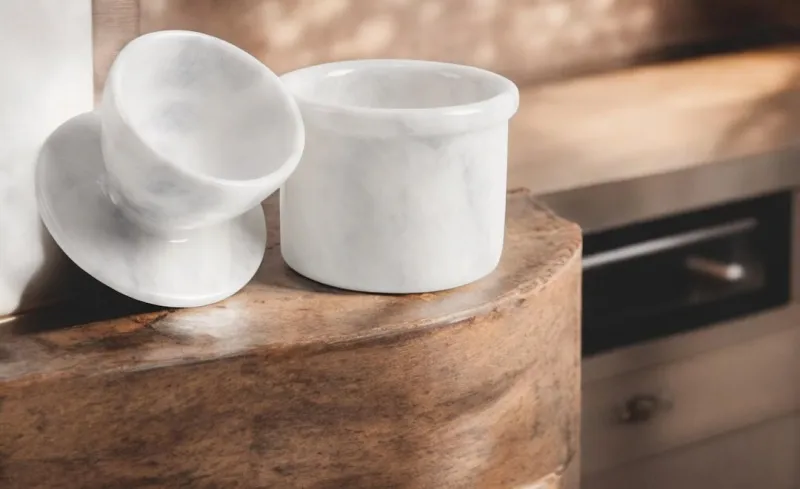
Photo: artisan French butter on marble kitchen surface rustic, via i.etsystatic.com
There is a moment in the preparation of a proper beurre blanc — that silken, ethereal sauce that seems to defy physics — when the cook must commit. The butter goes in cold, in pieces, whisked with patience and restraint over a flame that must be neither too high nor too low. The result, when achieved correctly, is not greasy or heavy. It is luminous. It is, in the most literal sense, a transformation.
This is what butter does in French cooking. It does not merely add richness. It changes the nature of what it touches.
American cooking has had a complicated relationship with butter for most of the past century — a relationship shaped not by taste or technique, but by anxiety. Understanding how that anxiety developed, and why France never shared it, reveals something fundamental about how two cultures have come to understand food, pleasure, and the body.
The French Premise
In the French culinary tradition, butter is not a condiment. It is a building material. From the earliest stages of a stock to the final mounting of a sauce, butter functions as both flavor and medium — a substance that carries aromatic compounds, creates emulsification, and produces the particular quality of richness that the French call onctuosité: a smoothness that coats without cloying, that satisfies without overwhelming.
French culinary philosophy, as codified through the work of Escoffier and refined through generations of professional kitchens, treats butter as a precision instrument. The quantity used is not a matter of excess but of calibration. A properly buttered sauce contains exactly as much as the dish requires — no more, no less. The goal is never richness for its own sake. The goal is depth, balance, and the sensation that a dish has been finished with care.
In Normandy, where some of the world's finest butter is produced from the milk of Normande cattle grazing on mineral-rich pastures, butter carries the additional dimension of terroir — the expression of a specific place and season in a specific flavor. A Normandy butter has a grassy, slightly tangy complexity that a generic American stick product simply cannot replicate. It is, in this sense, as nuanced as a wine.
The American Detour
The American relationship with butter diverged sharply in the mid-twentieth century. The low-fat dietary movement of the 1970s and 1980s, driven by a now-contested interpretation of cardiovascular research, positioned saturated fat — and butter in particular — as a dietary villain. Margarine, a product of industrial chemistry, was marketed as the healthier alternative. Butter was quietly removed from restaurant breadbaskets, reduced in recipes, or replaced entirely.
The cultural effect was significant. Butter became associated with guilt rather than craft. Home cooks who reached for it did so apologetically, as though breaking a rule. Restaurant menus that used it liberally — as any serious French kitchen must — were sometimes regarded with suspicion rather than appreciation.
What was lost in this decades-long detour was not merely flavor. It was the understanding of fat as a flavor carrier — the recognition that many aromatic compounds are fat-soluble and can only be fully expressed when a proper lipid medium is present. A sauté begun in butter does not merely taste richer than one begun in a neutral oil. It smells different, browns differently, and delivers a complexity of flavor that the oil simply cannot produce.
Reframing the Ingredient
The rehabilitation of butter in American culinary culture has been gradual but meaningful. The farm-to-table movement drew attention to the quality differential between artisanal cultured butters and commodity products. Chefs who trained in French traditions began explaining, publicly and in detail, why butter mattered and what it actually did. Food writers who had spent years demonizing the ingredient quietly reversed course as the nutritional science was reexamined.
Today, American consumers have access to cultured European-style butters, grass-fed domestic options, and small-batch regional products that would have been difficult to find in most markets twenty years ago. This is a genuine improvement — not only in availability but in cultural understanding.
The shift that matters most, however, is not about which butter you purchase. It is about how you think about it.
Butter as a Precision Tool, Not a Guilty Pleasure
French cooks do not use butter because they are unconcerned with health or because they have abandoned restraint. They use it because they understand what it does and how to deploy it with intention. A tablespoon of butter swirled into a pan of wilted greens at the last moment is not a concession to indulgence. It is a technical decision that lifts the dish, integrates the flavors, and creates a finish that no other ingredient achieves in the same way.
At Anisette Brasserie, this philosophy informs everything that leaves our kitchen. The sauces are mounted properly. The vegetables are finished with attention. The bread arrives with butter that deserves to be tasted, not merely used as a vehicle for something else.
For the home cook seeking to bring more of this quality to their own table, the practical implications are straightforward.
Buy better butter. A cultured European-style butter, or a quality grass-fed domestic option, costs marginally more and delivers substantially more flavor. Use less of it, used well, and the result will exceed what a larger quantity of inferior product could produce.
Add it at the right moment. Butter added early in a high-heat sauté will burn. Butter added at the finish — swirled in off the heat, or mounted into a sauce at a controlled temperature — will transform. Timing is everything.
Taste as you go. The question is never how much butter a recipe calls for. The question is whether the dish is balanced. Let your palate, rather than anxiety, guide the quantity.
What the Butter Tells Us
A culture's relationship with a single ingredient can reveal its broader assumptions about pleasure, restraint, and the purpose of food. France treats butter as a craft element — something to be understood, respected, and deployed with skill. America, for most of the past century, treated it as a moral question.
The French approach produces better cooking. It also produces a more honest and less fraught relationship with the table — one in which flavor is pursued without apology and pleasure is understood not as a departure from virtue, but as a form of it.
That is the lesson the butter has always been trying to teach us.