What the Calendar Knows: The French Brasserie's Devotion to Seasonal Cooking
In Paris, the arrival of white asparagus in late April is a culinary event. Menus across the city shift almost overnight. Chefs who have been preparing the same winter dishes for months suddenly pivot with evident pleasure, scrawling new offerings in chalk above zinc bars and across handwritten inserts tucked into leather-bound menus. The asparagus season lasts perhaps six weeks. Every cook in France knows this, and every cook treats those six weeks as something close to sacred.
This is not nostalgia. It is not marketing. It is the operating logic of a culinary culture that has always understood a fundamental truth: food tastes best when it is eaten at the precise moment nature intended it to be eaten.
The Architecture of a Seasonal Menu
In a traditional French brasserie, the menu is structured less like a catalog and more like a seasonal portrait. The plat du jour — the dish of the day — changes not just daily but in response to what the morning's market delivered. The broader menu evolves with each quarter of the year, and a chef who does not adjust with the seasons is regarded with the same mild suspicion one might reserve for a musician who plays only one key.
This organizational philosophy has deep roots. The French concept of terroir — a word most often associated with wine but equally applicable to cheese, produce, and livestock — holds that the character of a food is inseparable from the specific place and time in which it was produced. A strawberry grown in Périgord in June is not the same object as a strawberry grown in a California greenhouse in January, even if they share a name and a shape. One carries within it the accumulated warmth of a specific summer; the other carries the memory of nothing in particular.
"When we write a menu, we're not asking what we want to cook," explains Chef Antoine Moreau, who helms a classically minded brasserie kitchen in Lyon. "We're asking what the season is offering us, and then we're trying to honor that offer as faithfully as possible."
The American Industrial Counterpoint
The contrast with American food culture could hardly be more pronounced. The United States built its modern food system on the premise of year-round availability — the idea that a consumer in Minnesota should be able to purchase a tomato in February, a peach in November, or a butternut squash in May. This was, for a time, understood as progress: abundance without limitation, convenience without compromise.
The compromise, of course, was flavor. And quality. And, increasingly, environmental sustainability.
The American tomato has become something of a cultural shorthand for this problem. Bred for durability and uniformity, engineered to survive cross-country shipping, the supermarket tomato arrives at its destination technically intact and gastronomically inert. It looks like a tomato. It does not taste like one.
The French approach to the same ingredient is almost comically different. A French market vendor selling tomatoes in August will often offer five or six varieties — some lumpy, some striped, some barely red — and will speak of them with the pride of a vintner discussing a particularly good harvest. They are sold at peak ripeness, intended to be eaten within days. They taste, emphatically, like tomatoes.
How the Seasons Actually Divide
For home cooks seeking to align their kitchens with the French brasserie model, the first step is understanding what each season genuinely offers in their region of the country — not what the supermarket suggests is available, but what local farms and markets are actually producing.
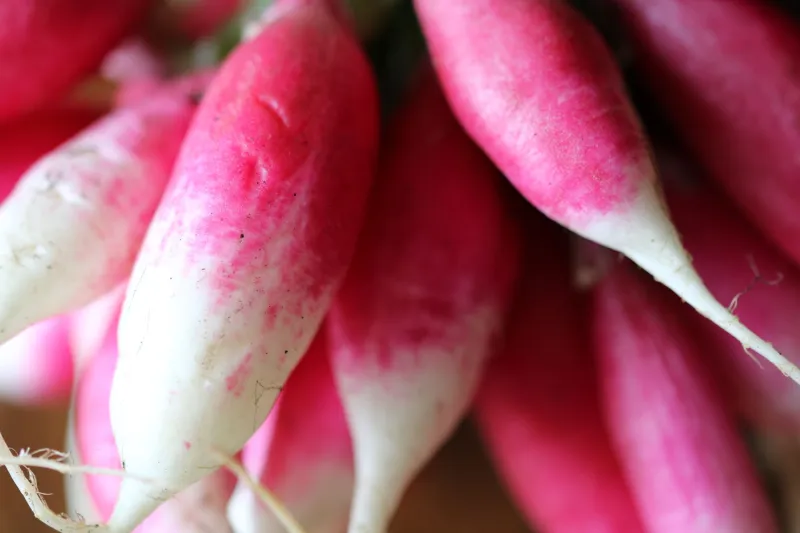
Spring in most of the continental US brings asparagus, ramps, peas, fava beans, radishes, and the first tender lettuces. The French brasserie answer to spring is lightness: salads dressed with walnut oil and a murmur of Dijon, asparagus served simply with browned butter and a soft-boiled egg, pea soups that taste almost green with freshness.
Summer is the season of abundance — tomatoes, corn, stone fruits, zucchini, eggplant, fresh herbs. This is the moment for the salade niçoise in its truest form, for ratatouille made with vegetables that actually need no coaxing, for cold vichyssoise on a warm evening.
Autumn brings mushrooms, squash, apples, pears, chestnuts, and the first game birds. The brasserie kitchen pivots toward richness: roasted duck with apple compote, mushroom-laden omelets, warm tarts filled with pear and frangipane.
Winter is the season of roots and braises — celery root, parsnips, turnips, slow-cooked beef bourguignon, onion soup that has been built over hours with patience and good stock. These are not consolation dishes. They are the season's proper gifts, accepted on their own terms.
Practical Guidance for the American Table
Adopting a seasonal approach does not require abandoning the supermarket entirely. It requires, rather, a reorientation of priorities — a willingness to ask not "what do I want to cook?" but "what is worth cooking right now?"
Farmer's markets are the most reliable guide. In most American cities, even mid-sized ones, weekly markets now operate year-round and offer a clear window into what the local agricultural calendar is producing. A brief conversation with a vendor will often yield more useful information than any cookbook.
For those without reliable market access, joining a local CSA (Community Supported Agriculture) subscription delivers the same seasonal discipline in a more structured form. The weekly box of whatever is ripe and ready imposes a welcome constraint — the same constraint that has shaped French brasserie cooking for generations.
"Constraints are not limitations," Chef Moreau reflects. "A chef who can cook anything at any time is a chef who has been given no direction. The seasons give us direction. They tell us what to cook, and they make us very good at it."
At Anisette Brasserie, that directional philosophy is woven into every menu decision. The calendar is not a restriction. It is, as any French cook will tell you, the most important ingredient in the kitchen.