Quiet Before the Day Begins: What the French Petit-Déjeuner Reveals About the American Breakfast Obsession
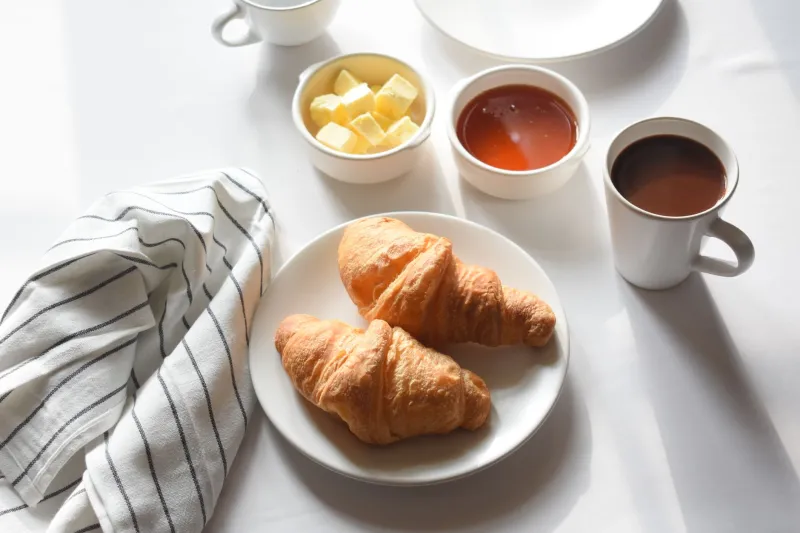
There is a particular kind of stillness that descends upon a Parisian café in the early morning hours. The chairs have just been unfolded, the espresso machine is warming to temperature, and the first delivery of croissants — still faintly warm from a nearby boulangerie — has been arranged with quiet precision behind the glass. A patron settles in, unfolds a newspaper or simply gazes toward the street, and begins what the French call the petit-déjeuner: the small breakfast.
Notice the word small. It is not accidental.
For Americans accustomed to breakfast menus that span multiple pages — offering everything from towering omelets to açaí bowls to smoked salmon Benedicts — the French approach to the morning meal can appear almost puzzlingly spare. A croissant, perhaps a tartine spread with good butter and jam, a bowl of café au lait or a demitasse of espresso. That is frequently all. No elaborate protein calculations, no meal-prep containers, no smoothie packed with seventeen ingredients. Just bread, coffee, and a few unhurried minutes before the world demands your attention.
Yet to dismiss this simplicity as mere frugality would be to misunderstand it entirely.
A Philosophy Disguised as a Pastry
The French petit-déjeuner is not a concession to laziness or indifference toward nutrition. It is, rather, an expression of a deeply held cultural conviction: that quality supersedes quantity, and that the beginning of one's day deserves the same deliberate care that the French apply to every other meal.
Chef Marie-Hélène Bouchard, who trained in Lyon before bringing her sensibilities to a French-inspired café in Chicago, describes it this way: "In France, you do not eat breakfast to fill yourself. You eat to begin yourself. There is a difference. The croissant must be exceptional — laminated properly, with real butter, baked that morning. The coffee must be strong and good. When those two things are right, you do not need anything else."
This distinction — eating to begin rather than to fill — cuts to the heart of what separates French and American breakfast culture. In the United States, breakfast has increasingly become entangled with wellness culture, productivity optimization, and the performative language of self-improvement. We speak of "fueling" our bodies as though we were machines requiring calibration before deployment. The French, by contrast, treat the morning meal as a sensory threshold — a moment of transition between sleep and wakefulness that deserves its own quiet dignity.
The Tyranny of More
It would be unfair to suggest that Americans have always approached breakfast with such intensity. For much of the twentieth century, a modest bowl of cereal or a piece of toast represented the national norm. The transformation came gradually, accelerated by diet culture, the rise of brunch as a social institution, and a food media ecosystem that rewards spectacle over subtlety.
Today, a quick scroll through any major American food publication reveals breakfast dishes engineered for visual impact rather than morning calm: pancake stacks glazed with compound butters, grain bowls requiring advance preparation, egg sandwiches assembled with the architectural ambition of a small building. These are not inherently bad things. But they carry an implicit message — that a simple breakfast is somehow insufficient, that restraint at the morning table signals a failure of imagination or ambition.
The French would find this exhausting. And, nutritionists are beginning to suggest, they might be onto something.
Dr. Simone Archambault, a registered dietitian based in New York who has studied European eating patterns, notes that the French tendency toward lighter morning meals is frequently accompanied by greater mindfulness at lunch — the meal the French treat as the true anchor of their day. "When you do not overload yourself at breakfast," she explains, "you arrive at midday with genuine appetite and genuine attention. The French lunch is not a rushed affair. It is a meal eaten with presence. And that presence begins with not having exhausted yourself at eight in the morning."
The Croissant as Cultural Statement
Central to the petit-déjeuner is, of course, the croissant — a pastry so thoroughly associated with French morning culture that it has become almost a cliché, yet one whose proper execution remains genuinely demanding. A well-made croissant is a marvel of technique: dozens of paper-thin layers of dough separated by high-quality butter, laminated through a process of repeated folding and chilling that can span two days. The result, when done correctly, is simultaneously flaky and tender, rich without being heavy, with a golden exterior that shatters pleasingly at the first bite.
In France, the croissant is rarely made at home. It is purchased fresh each morning from the neighborhood boulangerie, and this transaction is itself part of the ritual — a brief, civilized exchange that connects the diner to their community before the working day has begun. The pastry is typically eaten without embellishment, perhaps torn gently and dipped into coffee, perhaps accompanied by a small pot of fruit preserves.
At Anisette Brasserie, we have long believed that this simplicity is worth honoring. Our morning pastry program draws directly from this tradition — emphasizing technique, provenance, and restraint over novelty. A croissant that has been made properly needs nothing added to it. It is already complete.
Reclaiming the Morning
For American diners willing to experiment, adopting elements of the French breakfast philosophy requires less sacrifice than it might initially appear. It does not demand a wholesale abandonment of beloved morning habits. It asks, instead, for a shift in orientation.
Begin with sourcing. Seek out a local bakery — preferably one that produces its croissants or pain au chocolat in-house — and commit to purchasing something genuinely good rather than merely convenient. Invest in quality coffee, whether that means a French press, a stovetop moka pot, or simply a café that takes its espresso seriously. Sit down to eat, even briefly, rather than consuming your breakfast standing over the kitchen counter or in the car.
Resist the impulse to add more. Resist the smoothie, the egg white scramble, the protein supplement stirred into your oatmeal. Allow the morning to be small and sufficient. Notice how a single exceptional croissant, eaten slowly and with attention, can feel more satisfying than a plate piled with mediocre abundance.
The Quiet Luxury of Less
There is a kind of luxury in simplicity that Americans are only beginning to rediscover. The French have always understood it — that a morning meal elevated by quality and consumed with genuine presence is more nourishing, in every sense, than one engineered for caloric density or visual complexity.
The petit-déjeuner is not a deprivation. It is an invitation: to begin the day gently, to honor the senses before the noise of modern life crowds them out, to understand that the most civilized breakfast is often the quietest one.
Paris has known this for centuries. The table is set. All that remains is to sit down.