Midday, Reimagined: What the French Lunch Can Teach Americans About the Most Neglected Meal of the Day
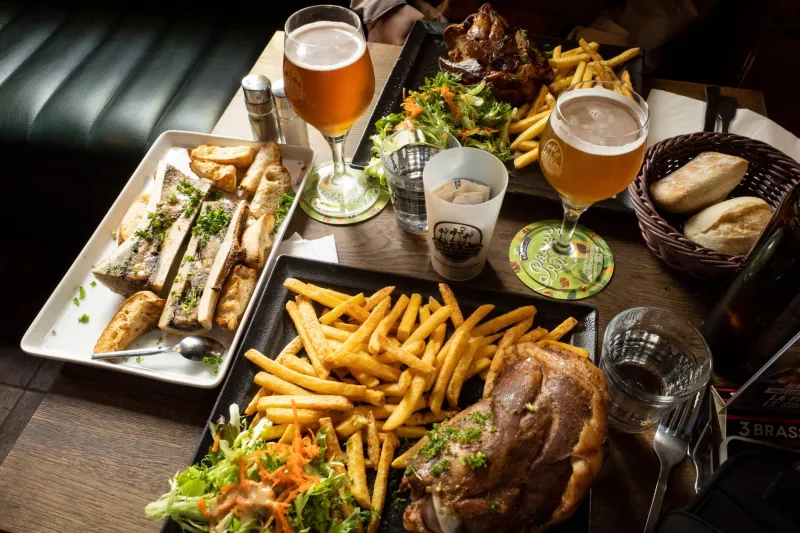
There is a particular kind of sadness to the American lunch. A container of leftovers balanced on a keyboard. A granola bar consumed between meetings. A drive-through sandwich eaten in a parking lot with one eye on a phone screen. For millions of working Americans, midday nourishment has been reduced to a logistical inconvenience — something to be managed, not savored.
In France, this arrangement would be considered not merely unfortunate but genuinely baffling.
The French déjeuner — the traditional midday meal — occupies a position of considerable cultural importance that has endured through centuries of social change, two world wars, and the relentless pressures of modern commerce. It is, by design, a proper meal: multiple courses, a glass of wine if the occasion permits, and, crucially, sufficient time to eat without distraction. That this tradition persists in an era of global productivity culture speaks not to French inefficiency, as some critics have lazily suggested, but to a deeply held conviction that how one eats is inseparable from how one lives.
American attitudes toward the midday meal appear, at last, to be shifting.
A Meal With Architecture
The structure of a traditional French lunch is worth understanding before one attempts to adopt it. Unlike the American approach — which tends to prioritize portability and speed above all else — the French midday meal follows a recognizable rhythm. An entrée, which in French culinary vocabulary refers to a starter rather than a main course, might be a simple composed salad, a slice of terrine, or a bowl of soup. The plat principal follows: a protein with vegetables, perhaps a modest grain. A cheese course or a light dessert completes the progression. The entire affair unfolds over an hour, sometimes longer, and conversation is understood to be as essential a component as the food itself.
This architecture is not incidental. It reflects a philosophy that eating well requires intention — that a meal assembled thoughtfully and consumed without haste produces a satisfaction that no hurried sandwich can replicate. French nutritionists and physicians have long pointed to the structured midday meal as a contributing factor in what observers have called the French Paradox: the seemingly contradictory combination of rich food and comparatively low rates of certain diet-related health conditions.
The Cost of Eating at Your Desk
American workplace culture has long treated the lunch hour as a negotiable luxury. Research consistently suggests that a significant majority of American workers eat lunch at their desks, and many report skipping the meal entirely on busy days. The consequences extend beyond mere nutrition. Studies in workplace psychology have linked regular breaks — particularly those involving meals taken away from one's workstation — to improved concentration, reduced stress levels, and measurably higher afternoon productivity.
The irony, then, is considerable. Americans forfeit the lunch hour in the name of efficiency and frequently emerge from the afternoon with less focus than their European counterparts who stepped away from their desks entirely.
Some forward-thinking American companies have begun to acknowledge this reality. Extended lunch breaks, communal dining spaces, and even employer-subsidized midday meals are appearing with greater frequency in progressive workplaces, particularly in cities with strong culinary cultures such as New York, San Francisco, and Chicago. The French model, while not always cited explicitly, is very much the spirit behind these initiatives.
Bringing the French Lunch Home
For those not bound by office culture — or for those fortunate enough to work from home — the opportunity to reclaim the midday meal is immediate and requires less effort than one might suppose.
The key lies in preparation rather than elaboration. A proper French lunch need not be time-consuming to assemble. A wedge of good cheese, a handful of dressed greens, a slice of pâté from a reputable charcutier, and a crusty baguette constitute a meal that is simultaneously effortless and elegant. The French home cook understands that quality ingredients, thoughtfully combined, require very little embellishment.
Soups are particularly well-suited to the midday table. A pot of leek and potato soup prepared on a Sunday evening will serve admirably for several lunches throughout the week, requiring only gentle reheating and the addition of a drizzle of crème fraîche before serving. Similarly, a simple salade niçoise — composed of good tuna, haricots verts, hard-boiled eggs, olives, and a brisk vinaigrette — can be assembled in minutes from pantry staples and delivers both sustenance and pleasure in equal measure.
The ritual matters as much as the recipe. Sitting at a table rather than a counter, using proper utensils, and allowing oneself twenty minutes of uninterrupted eating transforms even a modest meal into something restorative.
What Restaurants Are Beginning to Understand
American brasseries and French-inspired dining establishments have recognized an opportunity in this cultural recalibration. The traditional prix-fixe lunch — a two- or three-course menu offered at a price point considerably below the dinner equivalent — has been a cornerstone of Parisian restaurant culture for generations. It allows chefs to showcase their cooking to a broader audience while giving diners access to a complete, thoughtfully composed meal without the financial commitment of a formal dinner.
An increasing number of American restaurants are adopting this format, offering weekday lunch menus that honor the French structure without demanding the full ceremonial investment of an evening reservation. For the diner, it represents an extraordinary value proposition: the architecture of a proper French meal, available in the middle of an ordinary Tuesday.
At establishments like Anisette Brasserie, the midday meal is treated with precisely the seriousness it deserves. The lunch table is not a lesser version of the dinner table. It is simply the dinner table, illuminated by afternoon light.
An Invitation to Reconsider
Adopting the French approach to lunch does not demand a wholesale reorganization of one's life. It asks, rather, for a modest reordering of priorities — a willingness to treat midday nourishment as something worthy of one's full attention, however briefly.
The French have understood for centuries what Americans are only beginning to rediscover: that a well-spent lunch hour is not time stolen from productivity. It is, in fact, the foundation upon which a productive afternoon is built. To eat properly at midday is to arrive at the evening meal — and at the evening itself — with a clarity and contentment that no desk-bound sandwich can provide.
Paris has always known this. The table, set properly and attended to with care, is never a waste of time. It is, invariably, time exceptionally well spent.